
On Spencer Pratt
And people who participate in civic life only when their wealth is at risk

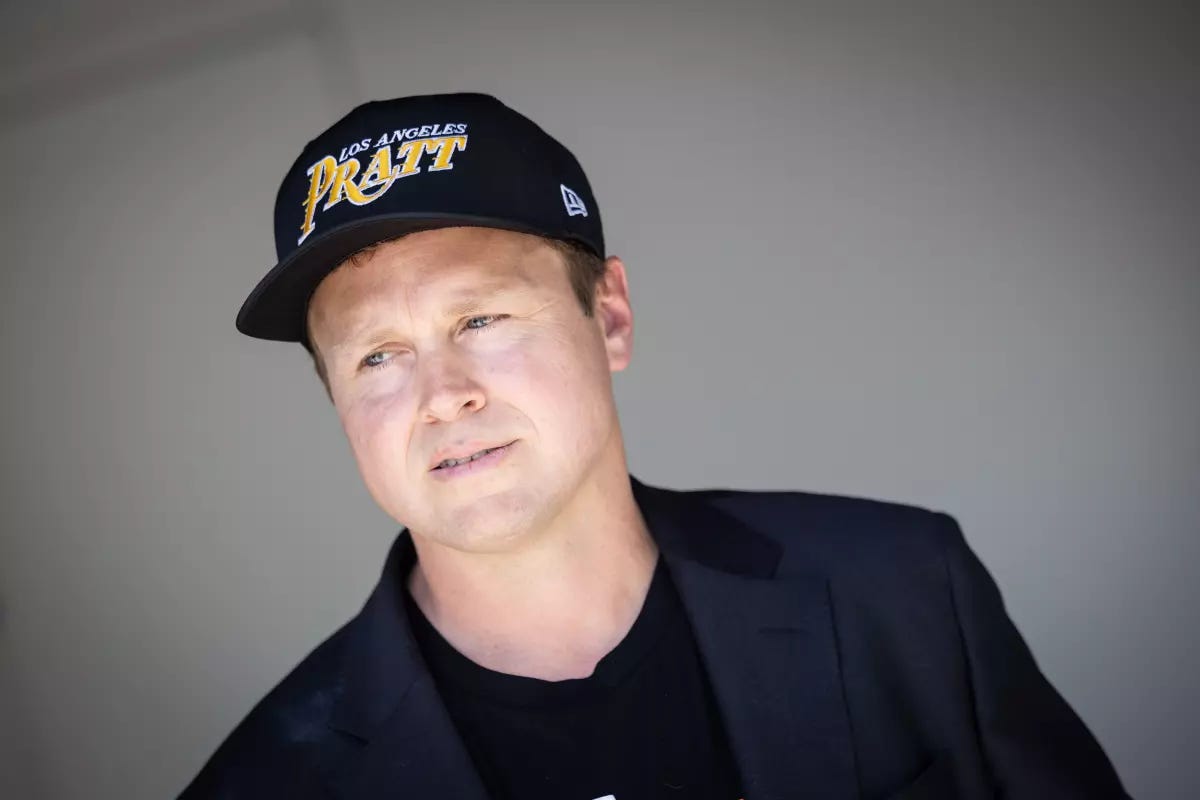
A FEW MONTHS AGO, I heard someone on the radio say that while she hadn’t been able to bring herself to vote for Donald Trump in the 2024 election, she was grateful that Trump had won.
It struck me as one of the most morally unserious statements I have ever heard – an act of political freeloading, like refusing to take part in a bank heist “on principle” and then reaching into the duffel bag to take your cut.
A similar dynamic, it seems to me, might be playing out right now in Los Angeles, where many people I know and love are performing the rituals of civic responsibility while rooting quietly for the grievance candidate.
We’ve seen this posture before.
One of my first jobs in government was working for the LA mayor. Like today, it was a time when of thousands of people were laying their heads on the pavement every night. My remit was to venture out into the city’s ritzy Westside neighborhoods and try to persuade people to get behind new affordable and homeless housing.
So on any given evening, on the Mayor’s behalf, you could find me presenting some new development in Venice or Brentwood or Mar Vista or Bel Air or Pacific Palisades. And on any given evening, residents of those neighborhoods would line up by the dozen to decry the urgency of “the homeless problem” – and vigorously oppose housing in their neighborhood.
It was a posture as consistent as it was absurd – nearly as absurd as it has been to watch a longtime resident of one of those neighborhoods – and, more importantly, someone who has never participated meaningfully in the life of the city – stand up and claim the mantle of the aggrieved in the race for Mayor of Los Angeles.
IN THE BEST OF TIMES, being Mayor of LA is one of the most difficult public sector jobs in the country. There is a decent case to be made that Los Angeles is not a governable entity at all – that it is actually an archipelago of discrete communities, each with unique and massively divergent needs which might be better served by smaller, hyperlocal governments. LA is also a weak mayoralty, meaning that compared to a place like New York, the mayor has relatively little formal authority to accomplish an agenda.
But even within these severe structural constraints, there is ample evidence that today City Hall is falling short of many of its most basic responsibilities.
Victims of the 2025 fires consistently say they have been left in limbo by slow rebuilding, tangled in red tape, and forced to fight insurers on their own. Homeowners across the city looking to do their small part, like build an ADU or install solar panels, report interminable waiting periods for permits.
And then there are the most vulnerable: Los Angeles is home to 170 high poverty neighborhoods, where more than 30 percent of households struggle to afford basic needs like food, rent, clothing, healthcare, and transportation. And cost of living keeps ticking skyward.
Like America after the financial crisis, the kindling was laid, a rebellion inevitable. Let down by their elected leaders, any one of these people could have taken up the mantle of change and led the revolt.
But instead of emerging from Skid Row or even from Main Street, the revolt is starting in the mansions. And should their revolution prevail, one must assume that their wealth will be the beginning and end of their priority list.
* * *
THERE IS A TERM that can help contextualize what we’re seeing: interest convergence – a phrase coined in the 1980s by the civil rights lawyer and scholar Derrick Bell.
The idea is that progress for marginalized people really only happens when it suits white elites – when the interests of the minority converge with the interests of the dominant majority. Bell came up with this framework after Brown v. Board of Education, the Supreme Court case that struck down “separate but equal” and started the process of school desegregation across the country.
Brown was the beginning of the end of legal segregation in America. But actually enforcing the decision was its own fight. In hundreds of communities across the United States, civil rights lawyers had to litigate to make sure Washington’s promises were made real in the lives of people all over the country.
Derrick Bell was one of those lawyers. And after watching how these cases played out, he concluded that even the Brown decision itself was only possible because the United States was fighting the Cold War and desegregation made America look good on the world stage.
The dominant majority will only ever agree voluntarily to level the playing field it it serves their interests too – if equality advances something the powerful already want. And sometimes that means that the most vulnerable can find breakthroughs inside that Venn diagram space.
But in LA, we’re not even seeing interest convergence. We’re watching a vision take hold from a MAGA Republican who can’t answer whether he will collaborate with ICE and who is looking to warehouse the city’s poverty.
* * *
WHY ARE SO MANY CEOs lining up behind Spencer Pratt’s bid for mayor?
Why, in Pratt’s telling, are billionaires who avoid taxes as a matter of principle now volunteering to “donate” earmarked funds to the city?
Why did Elon Musk and Jeff Bezos and Mark Zuckerberg throw their weight behind Donald Trump?
Because all of them see politics as a tool of power, and power as a means of protecting their wealth.
And you know what? They’re right.
Median household wealth for Latino and Black families in Los Angeles ($3,500 and $4,000 respectively) is about 1 percent that of whites ($350,000).
Someone advised me recently to stop talking so much about segregation – that since 2020, people have started tuning out when people talk about race and class.
We can stop talking about race and class when race and class stop being determinative of people’s material conditions. But today, Los Angeles is one of the most segregated cities in the United States – a phenomenon that has persisted in the city for generations.
It has persisted because we’ve long accepted policies and social norms devised to prevent communities of color from borrowing money and building wealth, keep upscale neighborhoods reserved for white, high-wealth Angelenos, and relegate large swaths of the city’s lower-income residents to areas of town that received inadequate investment.
It has persisted because, when it comes time to build new affordable housing in their neighborhoods – to make their communities more inclusive and affordable – residents show up in droves at community meetings and block the proposals from moving forward.
It has persisted because when they are aggrieved, when they don’t get exactly what they want, when their wealth is on the line, they decide it’s time for them to be mayor.
* * *
A PERSON’S NEIGHBORHOOD, tax bracket, or wealth should not in and of themselves inhibit them from seeking office or positions of public leadership. Candidates from West LA could present – and, indeed have in the past presented – a more inclusive vision. An approach that takes seriously the legacy of segregation and economic stratification. An approach that sees the whole city. This one does not.
You know how I know this is a scheme? Because Spencer Pratt has signed on to star in a reality TV show about being mayor if he wins the race. And if he loses, he says he will leave Los Angeles. Start to finish, the city and its people are vehicles for his grift. And for many of his supporters, Pratt is the vehicle for preserving their wealth. An alliance that deliberately locks the city’s most vulnerable people out of power.
Who is your community?
Is it the thirty people on your block in the wealthiest zip code in America? Is it the 200 families at your golf club? Or is it possible, in the year 2026, that we can finally begin to think more expansively about our civic commitments?
Civic life is not about getting everything we want the moment we want it. It is not an ultimatum, a gun to the head of the political system, in a bid to extort concessions. It is about participating, over years and even generations, in the hard work of building better places and fairer communities.
Vote for someone who is bought into that project.